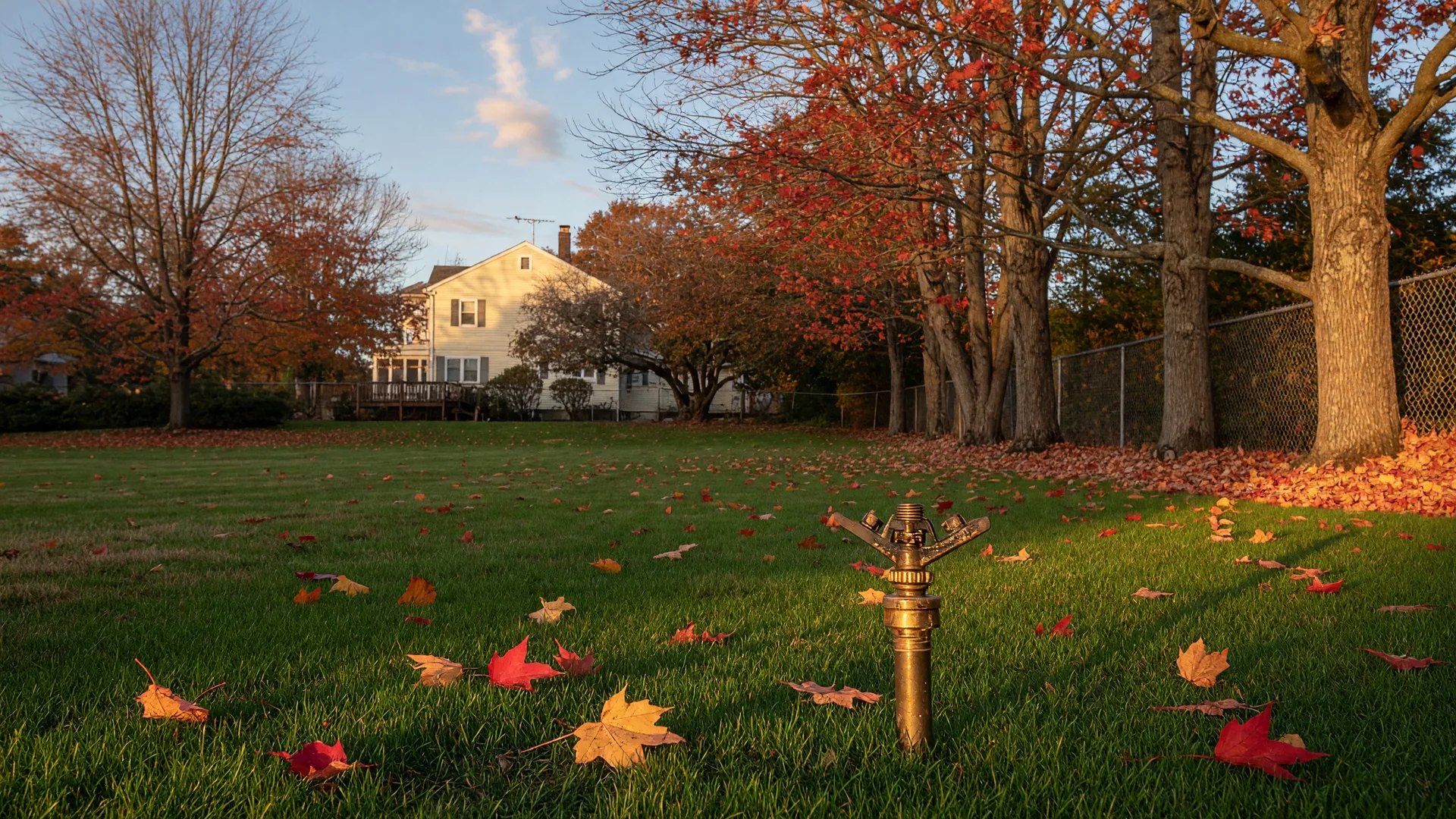
Winter is hardest on the parts of a Cinnaminson property that nobody thinks about until April: the irrigation lines buried a few inches under the lawn, the cool-season turf itself, and the leaf piles sitting at the curb. Almost every costly spring surprise can be prevented in October with a short checklist and one phone call. This guide covers when to blow out your sprinkler system, how short to cut the grass, what New Jersey's fertilizer law means for your last fall feeding, and exactly how Cinnaminson Township handles the leaves.
Why does winter lawn prep matter for Cinnaminson homes?
Cinnaminson's housing stock is mostly post-war construction, and the neighborhoods that make up the township, from Ramblewood and Fountain Farms to Poets Walk and Cinnaminson Harbor, sit on lawns that need real care. Most of those homes began with nothing but grass and a hose bib, so much of the underground irrigation you see today was added later, in pieces, by different installers. That matters in winter: a system installed piecemeal has more joints, valves, and low spots where water can sit and freeze.
A lawn buried under a mat of unraked leaves, mowed too short, or fed at the wrong time comes back patchy and thin. The turf itself is cool-season grass, typically tall fescue, Kentucky bluegrass, and perennial ryegrass. It does not die in winter; it goes dormant and comes back in spring, but only if it was set up to survive.
When is the first frost, and when should the yard work happen?
Burlington County's average first frost lands in the mid-to-late October window, with hard-freeze risk following in November, and Cinnaminson, along the Delaware just north of Philadelphia, usually tracks the slightly later coastal dates. For practical purposes, treat the end of October as the deadline for anything water-related outdoors and the middle of November as the deadline for feeding the lawn.
If the first hard freeze catches you by surprise, the irrigation system is the expensive casualty: water left in the lines expands as it freezes and cracks heads, valves, and fittings buried just inches down. A spring repair call costs at least as much as the blow-out, often several times more. Get the yard work on the calendar now while the weather is still pleasant.
How do you winterize an underground sprinkler system?
If you have an in-ground irrigation system, this is the single most important task on the list. A professional blow-out uses a large air compressor to force the remaining water out of every zone through the sprinkler heads, then drains the backflow preventer and shuts down the controller for winter. It takes a real compressor with enough volume and a pressure regulator, which is why most homeowners hand the job to a pro.
The cost is modest: professional winterization typically runs about $50 to $150 for a standard residential system, with extra zones adding $5 to $10 each, and most New Jersey homeowners pay in the $75 to $150 range. The catch is timing: October schedules fill fast, so call now rather than waiting for the forecast.
Local pros are easy to find. NaturaLawn of America operates right in Cinnaminson at 2702 Cindel Dr, Kurt's Complete Landscape and Lawncare is based nearby at 101 US-130, and Bailey Landscape Services in Maple Shade and Shane's Lawn Care Services in Palmyra both serve the township. When you call, ask three things: whether the blow-out includes a backflow drain, whether spring start-up is priced separately, and whether they can schedule you before the end of October.
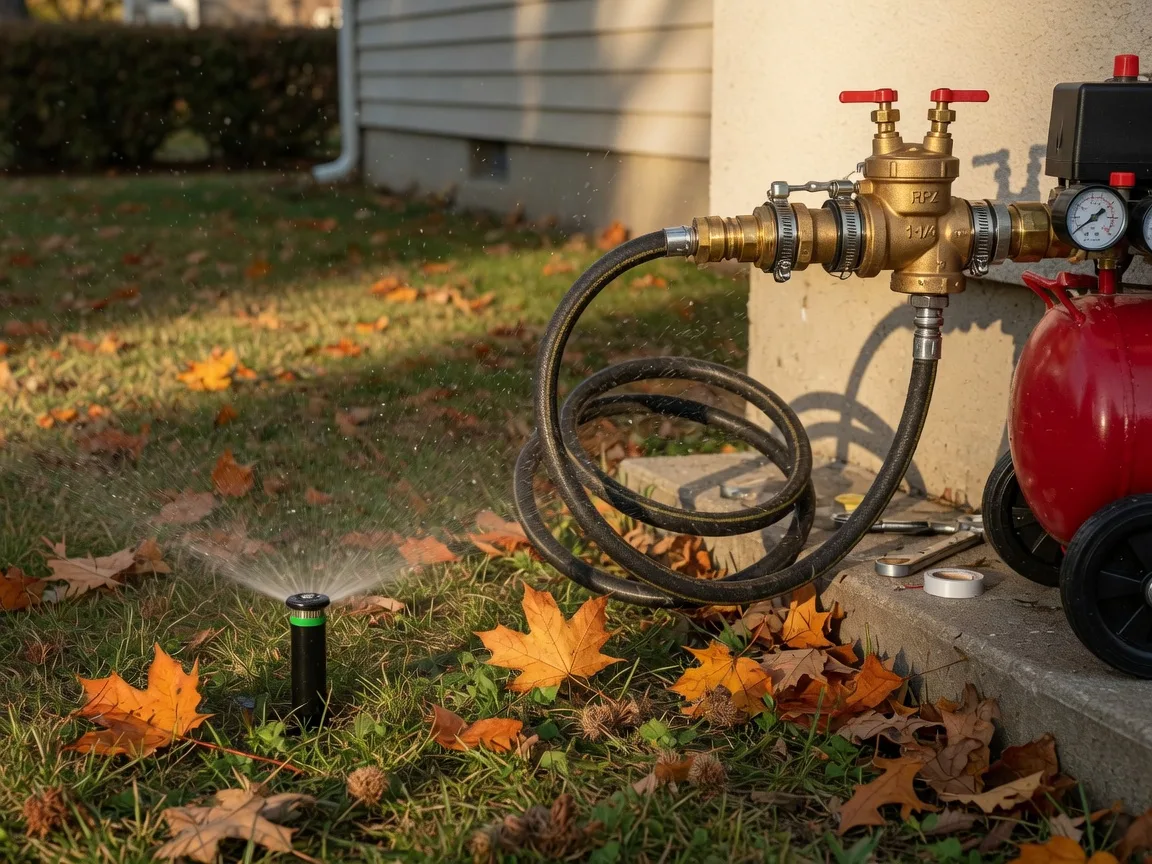
A pro blow-out drains every zone with compressed air, then closes the backflow valve for winter. Book before the end of October.
When should you stop mowing, and how short should the last cuts be?
Cool-season grass in New Jersey keeps growing well into the fall, slowing sharply only as soil temperatures drop below about 50 degrees, so you will often be mowing into November. Rutgers guidance is simple: keep the mowing height around 2.5 to 3.5 inches through fall, remove no more than one-third of the leaf height per cut, and do not scalp for winter. A low, shocking cut stresses the crown and invites winter damage and weeds.
Raise the deck rather than lowering it as the season winds down, and keep the blade sharp so cuts stay clean. If the lawn thinned over the summer, fall is the prime renovation window: aeration and overseeding now give new seed cool nights and warm days to root before dormancy.
What does the New Jersey fertilizer law say about your last fall feeding?
If you feed your lawn, mark November 15 before anything else: that is when New Jersey's homeowner fertilizer blackout begins, and lawn fertilizer containing nitrogen or phosphorus cannot go down again until March 1. Finish any fall feeding before that date, and most years the last application should be a winterizing blend heavy on slow-release nitrogen.
The same law caps how much you can put down: at least 20 percent of the nitrogen must be slow-release, no more than 0.9 pounds of total nitrogen per 1,000 square feet per application, and no more than 3.2 pounds per 1,000 square feet per year. Phosphorus is off the menu unless you are establishing new grass or a soil test shows it is needed. Never apply fertilizer to frozen or saturated ground, or within a day of heavy rain, because runoff heads straight for the creeks that feed the Delaware. When in doubt, skip the winter feeding entirely; a dormant lawn does not need it, and the Township's curbside leaf pickup removes the main reason lawns starve.
How should Cinnaminson homeowners handle the leaves?
New Jersey law keeps leaves out of the regular trash, and Cinnaminson Township collects them curbside in November, December, and April. The rules matter, because wrong bags get left behind: leaves must go in brown paper or recyclable leaf bags, never plastic, placed at the curb no earlier than one week before your scheduled pickup week and out by 7:00 a.m. Monday.
Pickup runs on the same section schedule the Township uses for brush: Section 1 is the first full week of the month, Section 2 the second, Section 3 the third, and Section 4 the fourth. Miss your week? Self-haul leaves and brush to the Recycling Center at the Public Works Building on Union Landing Road, open weekdays from 8:00 a.m. to noon, where screened leaf mulch is also available.
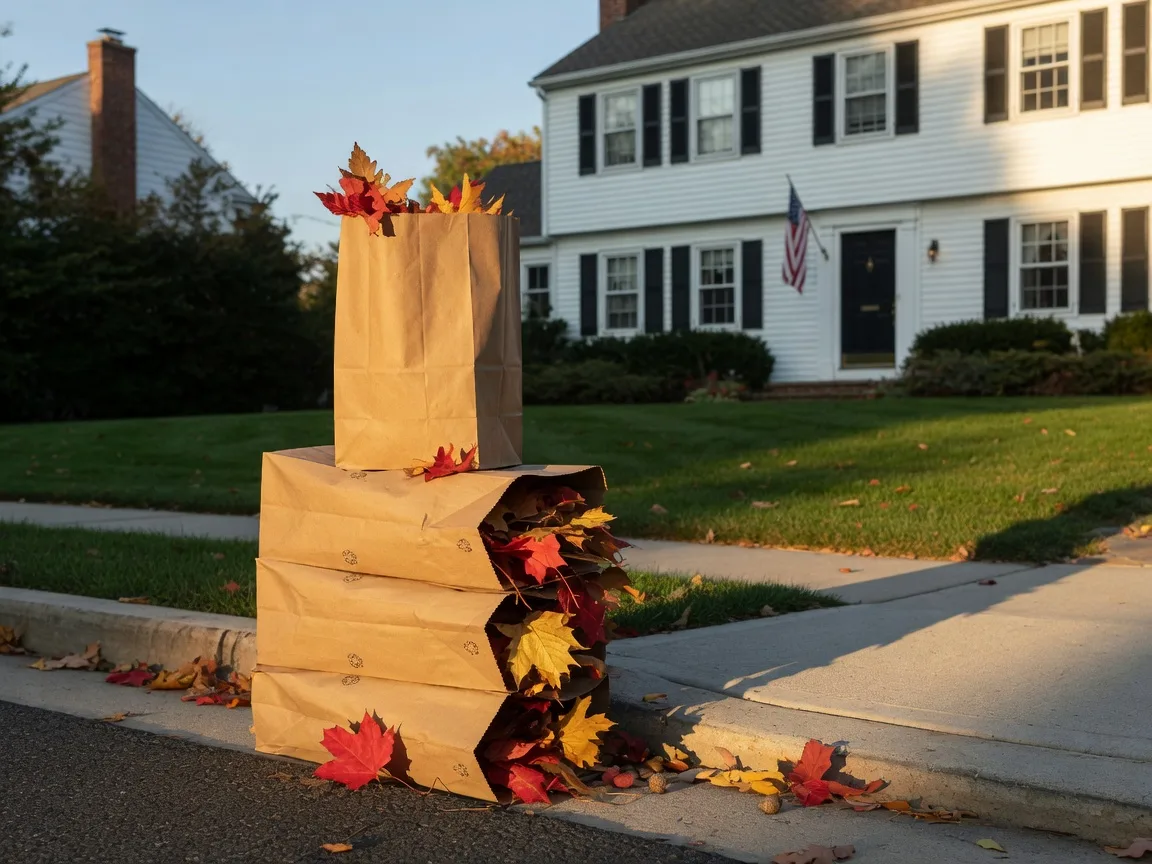
Cinnaminson collects leaves in November, December, and April, but only in paper leaf bags set out by 7:00 a.m. Monday of your section's week.
A light leaf drop can be handled entirely on the lawn: run a mulching mower over the leaves a few times and let the shreds break down into the turf, no bags required. Save the curbside pickup for the heavy weeks, and keep paper bags dry in the garage so they hold their own weight at the curb.
What else belongs on your yard's winter checklist?
Once the irrigation is blown out and the leaves are handled, a short list finishes the yard:
Drain and store hoses. Detach every garden hose, drain it, and store it inside; a hose left attached traps water against the faucet and turns a preventable freeze into an indoor leak. The faucet and pipe details are in our frozen pipes guide, and the house-side jobs live in the fall home maintenance checklist.
Stow the patio. Bring in or cover outdoor furniture, grills, and planters. Sealed ceramic pots crack when trapped moisture freezes, and frost-proof glazing is not frost-proof forever. Drain bird baths or tip them over, and store the pump from any fountain.
Protect only what is tender. Newly planted shrubs and borderline-hardy specimens benefit from burlap wraps or wind screens along exposed corners. Established native plants need nothing; wrapping everything invites rodents to nest in the insulation.
Wait on the mulch. If you mulch beds in fall, wait until the ground has cooled so the mulch insulates roots instead of trapping summer heat, and keep it off tree trunks.
Put the mower away properly. Run the gas out or add stabilizer, disconnect the battery on riders, and store the mower clean. A little effort in November saves a carburetor rebuild in April.
Does a well-kept yard matter when you sell a Cinnaminson home?
It does, and more than most owners realize. The front yard is the first thing a buyer sees in listing photos, and winter is when a neglected yard shows worst: matted leaves, a dead zone where the sprinkler head failed, scorched turf along the walk. A property that went through the winter protected, with drained irrigation and a clean lawn, photographs better in March and inspects cleaner in April. Our real estate market page tracks what well-maintained Cinnaminson homes are selling for, and the neighborhood guide shows how lot sizes and yard expectations differ from Ramblewood to Cinnaminson Harbor.
If you are weighing what it really costs to own a home here, the cost of living breakdown puts seasonal services like blow-outs, leaf removal, and lawn care into the monthly picture alongside taxes and utilities.
Lawn winterization in Cinnaminson: Your questions, answered
When should I winterize my sprinkler system in Cinnaminson, NJ?
Before the first hard freeze. Burlington County's average first frost lands in the mid-to-late October window, with hard-freeze risk in November, so most local pros aim to finish blow-outs by the end of October. Book early.
How much does it cost to blow out a sprinkler system in New Jersey?
About $50 to $150 for a standard residential system, with extra zones adding $5 to $10 each. In New Jersey, most homeowners pay in the $75 to $150 range, far less than a spring repair call.
Does Cinnaminson Township pick up leaves at the curb?
Yes, in November, December, and April, by section. Leaves must be bagged in brown paper or recyclable leaf bags, placed out no earlier than one week before your scheduled week, and at the curb by 7:00 a.m. Monday.
Can I put leaves in plastic bags for Cinnaminson leaf pickup?
No. Public Works only accepts brown paper or recyclable leaf bags, and New Jersey law keeps leaves out of the regular trash. You can also self-haul to the Recycling Center on Union Landing Road on weekday mornings.
When should I stop fertilizing my lawn in New Jersey?
New Jersey bars homeowners from applying nitrogen or phosphorus lawn fertilizer between November 15 and March 1. Finish any fall feeding before November 15, with at least 20% slow-release nitrogen and no more than 0.9 pounds of total nitrogen per 1,000 square feet.
How short should I cut my grass before winter?
Keep cool-season lawns around 2.5 to 3.5 inches through fall and do not scalp them for winter. Keep mowing while grass is still growing, often into November in New Jersey, cutting no more than one-third of the leaf height at a time.
A neighborly reminder
I have walked the lawns of this township for years, and I still book my own sprinkler blow-out before the first frost call every October. The yards that come through winter best are the ones whose owners spent one pleasant weekend and one short phone call. If you need a local pro, are thinking about selling in spring, or just wonder what your home needs before the freeze, I am happy to point you in the right direction.
Have questions about Cinnaminson? Contact Bob Millaway at 856.426.1522
Contact Bob